
When the geostationary amateur radio satellite Es’hail-2 (QO-100) appeared in the sky in 2019, the idea of a SOTA activation crossed my mind. After a few preliminary tests, the portable transceiver setup was finally ready for action. The goal was to keep everything as small, lightweight, and inexpensive as possible.
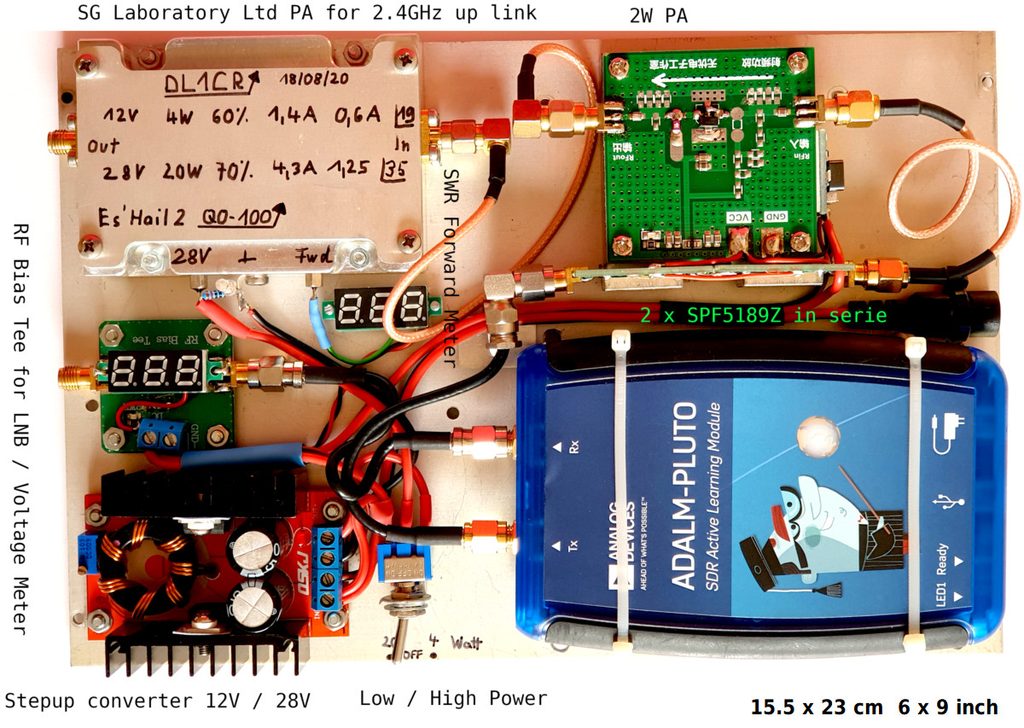
- Adalm-Pluto SDR (modified 1) with an external laptop and SDR software
- Two SPF5189S 2.4 GHz amplifier modules in series and a 2W PA (modified 2) sourced from China for just a few euros
- 20W PA (modified 3) for 2.4 GHz and 28V from Bulgaria (SG Laboratory Ltd)
- A 12V-to-28V step-up converter from China (low cost)
- Two digital voltmeters: one for operating voltage, one for output power
- LNB
Reception at 10 GHz was adequate using a 40 cm satellite dish; for 2.4 GHz, a 4-element PCB antenna placed at the dish’s focal point sufficed.
Modifications
- The built-in XO (crystal oscillator) in the Pluto lacked stability and was replaced with a 0.5 ppm TCXO. With some SMD soldering experience, the replacement was quite manageable.
- The gain of the 2W PA dropped significantly at 2.4 GHz. I found an online guide describing how to modify the output network by adjusting SMD capacitors in the 1–2 pF range.
- I internally re-soldered the SWR measurement port from the reflected power path to the forward power path.
After a few QSOs—including contacts with the Antarctic station Neumayer (DP0GVN) and an S2S (Summit-to-Summit) QSO—I soon lost interest. Perhaps someone here would like to arrange an S2S or „chase“ QSO.